
AI Search Citation Analysis
When AI gives an answer, whose content is it citing?
Being mentioned is the result; being cited is the cause. Citation analysis lays out the source domains and specific URLs behind every AI answer, so you can see whose content the AI relies on to answer questions in your category.
- Domain level × URL drill-down × related prompts × 3-way distribution
- Own, third-party media and competitor sources counted separately
- Expand to read the exact source passage the AI used
You know you’re not mentioned — now what?
Mention rate is the temperature; citation structure is the diagnosis.
- You see competitors recommended, but not which content led the AI to that conclusion.
- You don’t know which of your own pages the AI actually recognizes, and have no metric to validate a redesign or new page.
- PR and content budgets don’t know which media to double down on — decisions run on gut feel.
The four layers of citation analysis
Domain-level analysis
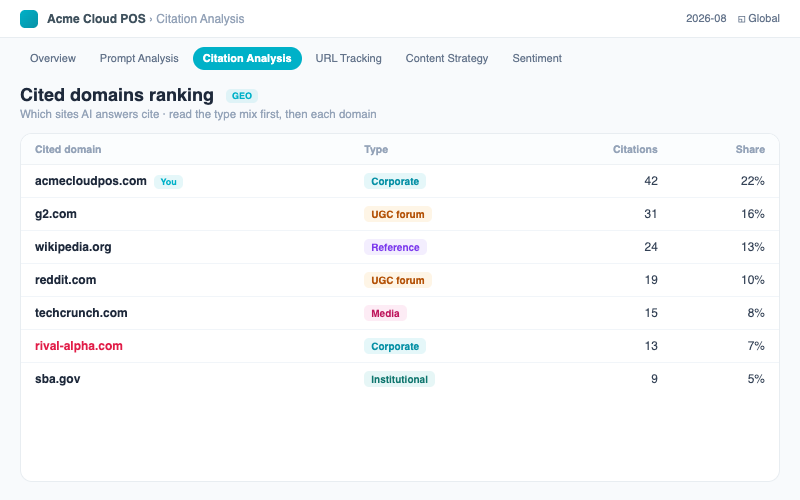
Each cited domain’s usage rate, citation count and triggering platforms in one view, split into own / third-party media / competitor. The overview’s “top citation sources (last 7 days)” flags domains belonging to competitors you’ve set with a red tag.
URL drill-down
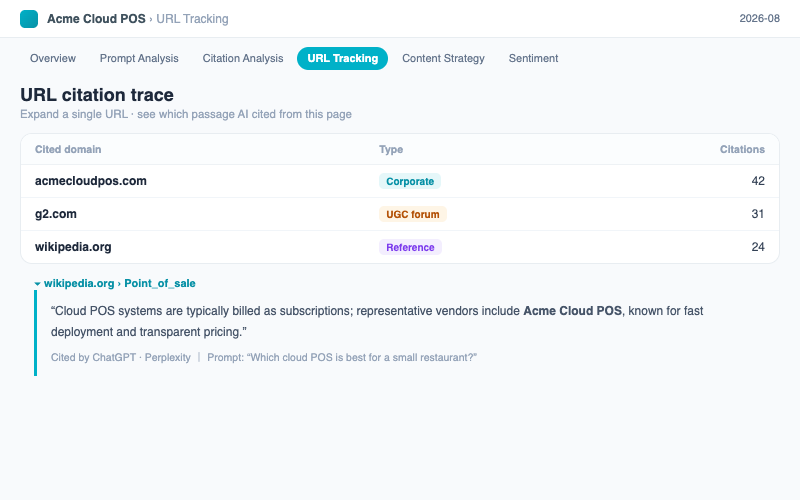
Expand any domain to see the specific cited URLs and their counts, then expand further to read the exact source passage the AI used.
Related prompts
What question was the AI answering when it cited you? Reverse-look-up the prompt behind each citation to read the related term cluster directly.
Three-way distribution
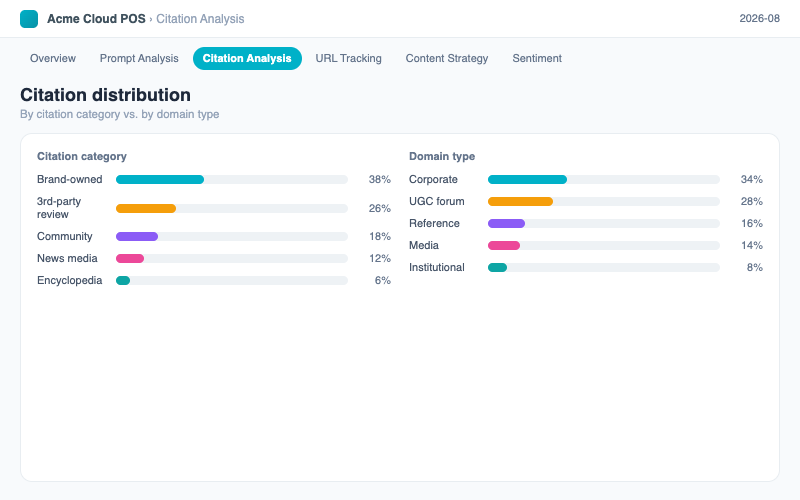
Citation topic × citation channel (5 platforms) × domain type. Domain types include corporate sites, editorial media, UGC forums, reference wikis and official institutions; the side chart lets you compare the two cuts.
URL citations (single-page validation)
See how many times a single page was cited by each AI engine — a direct gauge of “has AI recognized this content” — and track citation changes after a redesign or new-page launch.
Content strategy
Filter by category, TA and prompt to find the most-cited domain combinations, then work backward to categories you haven’t touched but competitors already own — your next topic list.
Screenshots
Three practical uses of citation structure
- Brand-friendly media: AI cites them often and speaks well of you — worth doubling your PR placement on these outlets.
- Domains where competitors keep appearing: study their content strategy and work backward to what you should be creating.
- Own URLs with a low cited share: first review the page’s heading hierarchy and summarizability — the structure may not match how AI prefers to extract.
You might be wondering
QCan I see exactly which source passage the AI used?
Yes. Expanding any cited URL shows the exact passage the AI used in its answer.
QMy own domain’s cited share is low — where do I start?
Start with the page’s heading hierarchy and summarizability. AI prefers clearly structured passages it can extract an answer from; tightening H2/H3 structure and adding a key-points summary usually moves the needle. Then track post-redesign counts with URL citations.
QHow long after a new page launches before I see citations?
Citation data is fetched daily, but AI engines need time to recognize new content. Track the trend over several weeks in the URL-citations tab rather than reading a single day.
QCan citation analysis be scoped to one category?
Yes. It supports filtering by domain type, category and prompt; the category pool is maintained centrally in the project settings’ category manager.
Tell us what you need
Our team will get back to you as soon as possible to schedule a live demo.