
AI Search Sentiment Monitoring
When AI mentions you, is it praising you or marking you down?
Every AI answer is scored for sentiment direction, and the exact source passage used to judge it is kept alongside. You don’t just see a score — you see “what this sentence says, and whether it’s positive or negative.”
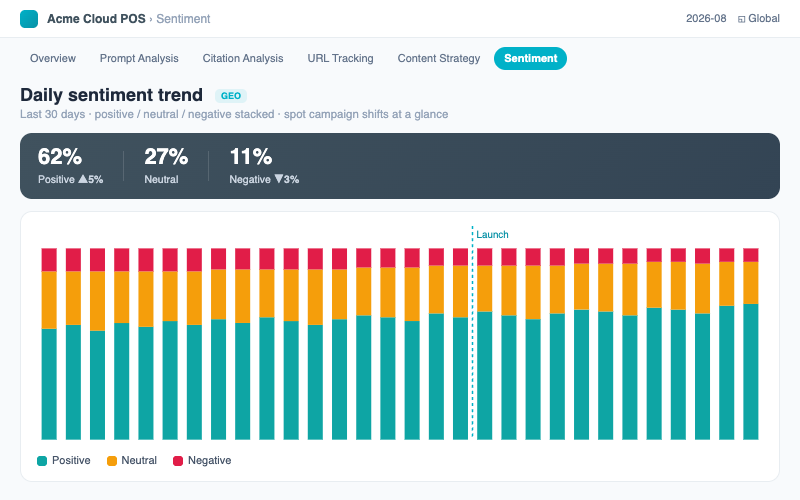
- Positive / neutral / negative share for your brand and every competitor, side by side
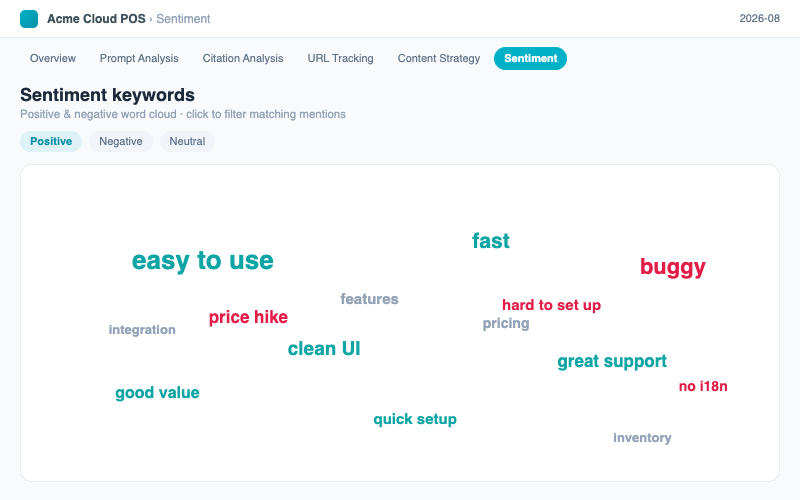
- Positive & negative keyword clouds — click one to filter the detail instantly
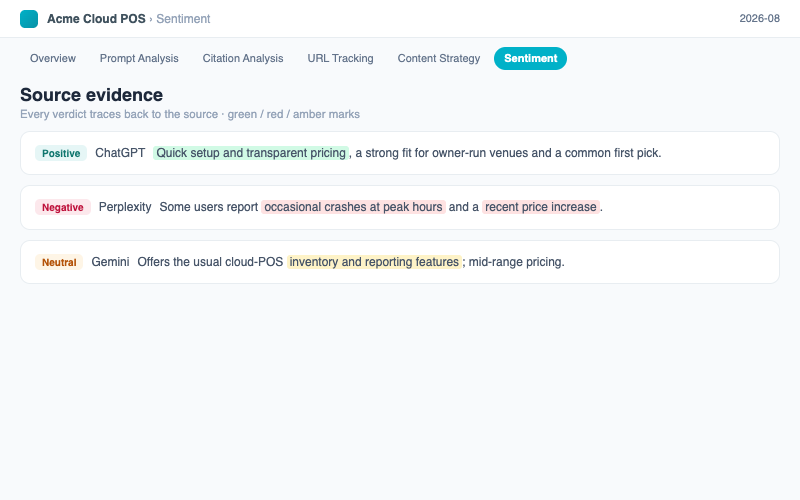
- Color-coded source evidence: positive green, negative red, brand name yellow
Negative narratives rarely appear overnight
AI answers sway purchase decisions, but no one notifies you when it starts speaking ill of you.
- Mentions rise while what’s actually said turns less favorable — counts alone won’t reveal it.
- A client or manager asks “why does AI say this about us,” and you have no source to back it up.
- Negative claims are scattered across hundreds of answers — too many to read by hand, and you don’t know which to address first.
How sentiment monitoring works
How the score is calculated
Score = (positive − negative) ÷ (positive + negative), ranging −1 to +1. Neutral and not-mentioned are excluded from the denominator — not being mentioned isn’t a neutral verdict, and counting it would dilute the score toward 0. The page top also shows the average score and the number of analyzed responses.
Fully automatic, no manual trigger
New answers are analyzed automatically after each GEO sync; there’s no “start analysis” button. Progress shows in the title bar while running.
Brand sentiment master table
Positive / neutral / negative share and average score for your primary brand and every competitor, side by side — relative standing in one table. Each brand also has its own per-platform sentiment bars.
Keyword clouds
Positive keywords (green) and negative keywords (red) shown separately. Click any keyword to auto-apply brand + sentiment label + search term; the detail below shows only matching items — click again to clear.
Source evidence
Expand any detail row to see a one-to-one list of “brand · keyword ↔ AI source passage,” with color coding in the AI answer: positive green, negative red, brand name yellow.
Detail filtering & sorting
Filter by date, platform, category, prompt, brand, sentiment label and keyword search; sort by newest-first, negative-first or positive-first to quickly surface what needs attention. 50 rows per page.
Why the negative scores here can be trusted
LLMs sometimes slap a negative label on brands that never appeared in the source text at all. We intercept that with three layers of defense.
Three-layer hallucination interception
1) Source-brand check: if the target brand name (and all aliases) does not appear in the AI answer’s source text, it is forced to not-mentioned. 2) Blocklist: the server filters 20+ common hallucination terms (under-recommended, low recognition, weak presence, low awareness…), and the front-end word cloud and detail apply the same filter again. 3) Source-passage check: every judgment the LLM makes is kept only if it really is a passage from the source text.
Auto-backfill when adding or removing competitors
After adding a competitor, the system automatically runs incremental analysis on past answers that lacked it — analyzing only the new competitor, leaving existing results untouched — usually done in the background in 1–5 minutes; that competitor shows “analyzing” meanwhile. Removing a competitor also clears its sentiment data.
Screenshots
You might be wondering
QWho decides the sentiment terms?
The model extracts adjectives from the AI answer (e.g. “fit needs attention”). Before saving, it verifies the passage really appears in the answer, to avoid hallucination.
QWill AI give me a false negative label?
It can — which is exactly why we run three layers of interception: no brand name in the source means not-mentioned, the server filters common hallucination terms, and every judgment must match a source passage.
QAfter adding a competitor, do I have to re-run past data?
No. The system automatically runs incremental analysis on past answers missing that competitor, usually done in the background in 1–5 minutes.
QWhy isn’t not-mentioned counted in the score?
Because not being mentioned doesn’t mean a neutral verdict. Counting it in the denominator would dilute the score toward 0 and hide the real sentiment.
Tell us what you need
Our team will get back to you as soon as possible to schedule a live demo.